[Check Latest Arrivals kitchen sink spray head replacement on Amazon.]
# How to Replace a Kitchen Sink Spray Head: A Step-by-Step Guide
Is your kitchen sink spray head dribbling, spraying sideways, or just plain broken? Don’t worry, you don’t need to call a plumber! Replacing it is a surprisingly easy DIY project that anyone can handle with a few simple tools and this step-by-step guide.
We’ll walk you through each step, from identifying the type of spray head you have to installing the new one. Plus, we’ll share some Pro-Tips to make the process even smoother. Let’s get that sink working like new again!
### Step 1: Identify Your Spray Head Type
Before you even think about taking anything apart, take a good look at your existing kitchen sink spray head. There are generally two main types:
* **Side Sprays:** These are the most common type. They sit to the side of the faucet and are connected by a hose that runs under the sink.
* **Pull-Down Sprays:** These are integrated into the faucet itself. The spray head pulls down from the faucet spout.
Knowing which type you have will help you understand how it’s connected and choose the correct replacement.
### Step 2: Gather Your Tools
* **Adjustable Wrench:** For loosening and tightening connections.
* **Basin Wrench (Optional):** Helpful for reaching tight spaces under the sink.
* **Penetrating Oil:** To loosen corroded connections. WD-40 Specialist Penetrant is a great formula for any type of DIY situation.
* **New Spray Head:** Make sure you get the right type (side spray or pull-down) and that it’s compatible with your faucet’s brand and connection type.
* **Old Towels or Bucket:** To catch drips and spills.
* **Plumber’s Tape:** For sealing threaded connections.
* **Gloves:** To protect your hands.
### Step 3: Turn Off the Water Supply
This is crucial! Locate the shut-off valves under your sink (one for hot water and one for cold). Turn both valves clockwise until they are completely closed. If you don’t have shut-off valves, you’ll need to turn off the main water supply to your house.
### Step 4: Disconnect the Old Spray Head (Side Spray)
1. **Disconnect the Hose:** Under the sink, find where the spray head hose connects to the faucet. This connection will likely be a threaded fitting or a quick-connect clip.
* **Threaded Fitting:** Use your adjustable wrench to loosen the fitting. Turn it counterclockwise. Be prepared for some water to spill when you disconnect the hose.
* **Quick-Connect Clip:** Look for a small plastic clip on the fitting. Squeeze or press the clip to release the hose. Again, have a towel handy.
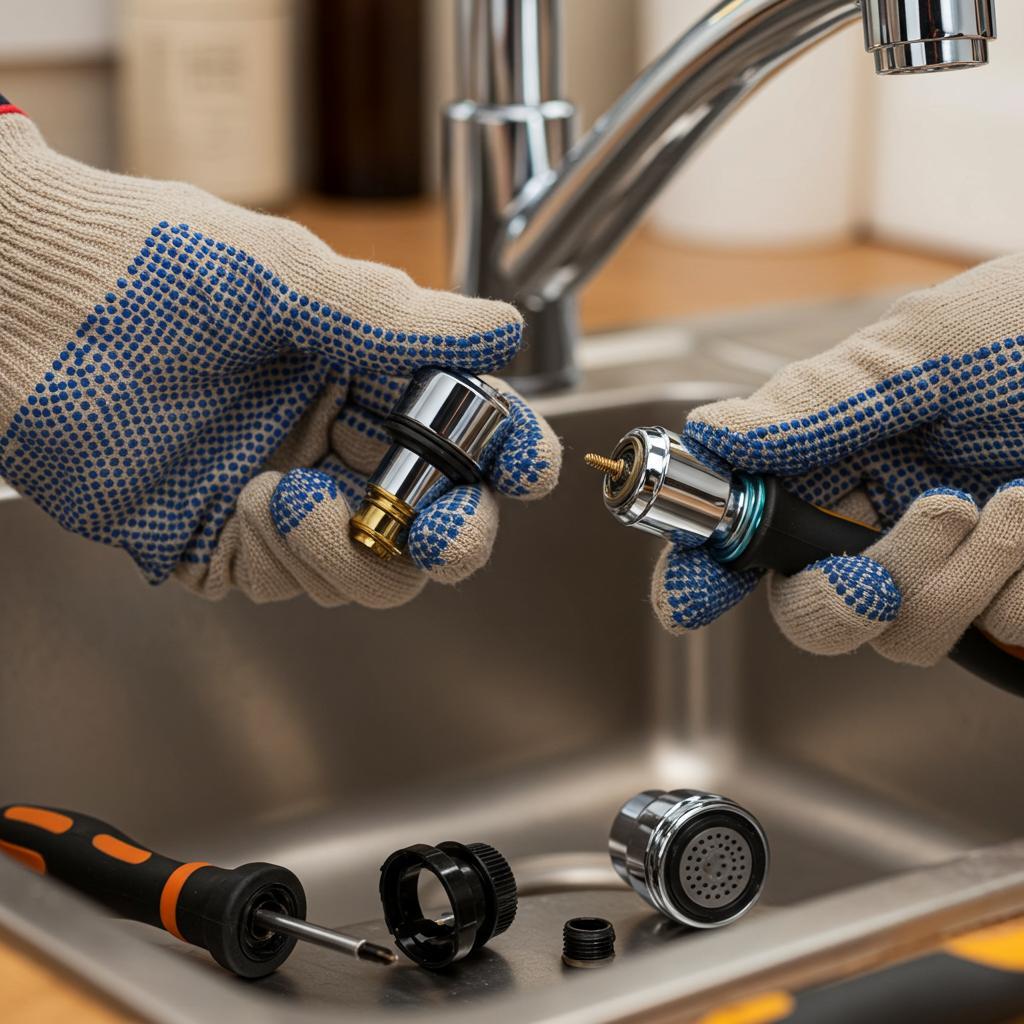
2. **Remove the Spray Head:** Once the hose is disconnected, you should be able to easily unscrew or detach the spray head from the hose above the sink. Some side sprayer heads have a retaining nut underneath that also needs to be loosened.
### Step 5: Disconnect the Old Spray Head (Pull-Down Spray)
1. **Locate the Weight:** Follow the hose down from the faucet spout. You’ll likely find a weight attached to the hose. This weight helps the spray head retract smoothly. Take note what keeps it in place, it could be a clip-on part or a screw.
2. **Disconnect the Hose:** Under the sink, find the quick-connect fitting similar to a side spray, that connects the hose to the faucet. Disconnect the hose.
3. **Pull out the old head.** Remove the weight by following the appropriate direction that goes for the type of weight that you have.
### Step 6: Clean the Hose and Connection
Use a clean cloth to wipe down the hose and the faucet connection point. Remove any old plumber’s tape or debris. If the threads on the faucet connection are corroded, you can use a wire brush to clean them up.
### Step 7: Install the New Spray Head
1. **Apply Plumber’s Tape:** Wrap the threads of the faucet connection with plumber’s tape. Wrap it clockwise, overlapping each layer. Two or three wraps should be sufficient.
2. **Connect the Hose (Side Spray):** Attach the spray head hose to the faucet connection. Tighten the fitting with your adjustable wrench. Don’t overtighten, as this could damage the threads.
3. **Connect the Hose (Pull-Down Spray):** Feed the hose through the faucet spout. Re-attach the weight in the same spot you removed it. Connect the quick-connect fitting to the faucet.
### Step 8: Test for Leaks
Turn the water supply back on slowly. Check the connection points for any leaks. If you see a leak, turn off the water, tighten the connection a little more, and retest.
### Step 9: Final Checks
* Make sure the spray head sits properly in its holder.
* Test the spray head to ensure it functions correctly. Check for proper water flow and spray patterns.
* For pull-down sprayers, ensure that the hose retracts smoothly.
That’s it! You’ve successfully completed a kitchen sink spray head replacement.
[Explore Top Rated kitchen sink spray head replacement on Amazon.]
## Tools for the Job
While replacing your kitchen sink spray head is generally straightforward, having the right tools can make the process even easier and more efficient. Here are a couple of recommendations to ensure a smooth experience:
* **WD-40 Specialist Penetrant:**
* **Key Features:** Fast-acting, anti-rust formula, loosens stuck parts.
* **Why We Like It:** This penetrant is formulated to quickly break down rust and corrosion, making it easier to loosen stubborn connections. Perfect for older sinks where fittings may be seized up. It also helps prevent damage to the threads. A must for any DIY toolkit.
* **Adjustable Basin Wrench:**
* **Key Features:** Spring loaded, pivoting head.
* **Why We Like It:** Basin wrenches are essential for working in those tight spaces under the sink. The spring-loaded head enables you to easily maneuver the wrench and remove stubborn connections with ease.
[Explore Top Rated kitchen sink spray head replacement on Amazon.]
## Pro-Tips and FAQs
* **Can I use any kitchen sink spray head replacement?** Not necessarily. Make sure the new spray head is compatible with your faucet’s brand and connection type. Check the manufacturer’s website or the product description for compatibility information.
* **The spray head leaks even after replacing it. What should I do?** First, double-check that you’ve used plumber’s tape properly. Make sure the connection is tight but not overtightened. If the leaking persists, the faucet valve seat may be corroded. This requires professional assistance from a local plumber.
* **How do I prevent my kitchen sink spray head replacement from becoming corroded?** Wipe down the spray head and faucet regularly to remove water spots and soap residue. Consider using a water-softening system if you have hard water. If you have some mineral build up, CLR Calcium, Lime, and Rust remover spray can help resolve that issue.
* **The water pressure is low after replacing the kitchen sink spray head replacement – what might be the problem?** Check the aerator of the spray head for mineral build-up. You can remove and clean the aerator to improve the water flow.
[Explore Top Rated kitchen sink spray head replacement on Amazon.]
## Conclusion
Replacing a kitchen sink spray head is a simple and satisfying DIY project that can save you money and restore the functionality of your sink. By following these step-by-step instructions, you’ll have your sink working like new again in no time. Don’t be intimidated – with the right tools and a little patience, you’ve got this! Enjoy your newfound plumbing skills!
[Shop Budget-Friendly kitchen sink spray head replacement on Amazon.]